
These days, we’re surrounded by health product marketing:
“Rich in collagen!”
“Contains billions of probiotics!”
“Packed with botanical extracts!”
But before you add it to your cart, ask yourself:
Can your body actually absorb and use what you’re paying for?
The truth is—what matters isn’t just what’s inside the product.
It’s what your body can actually access and absorb.
💡 So, what is Bioaccessibility?
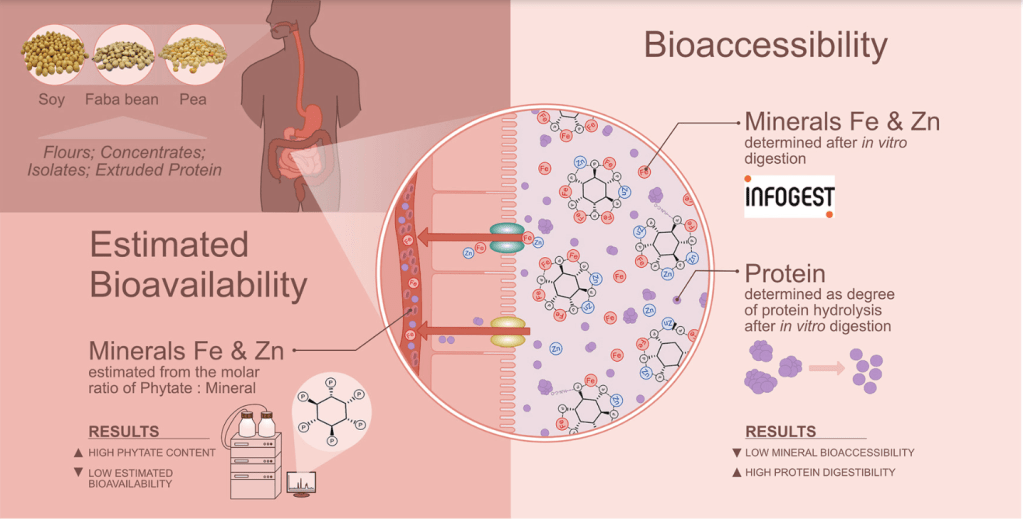
Bioaccessibility refers to the amount of a nutrient or compound that is released from a supplement during digestion and becomes available for absorption by the body.
In simpler terms:
✅ It’s not about how much you eat.
❌ It’s about how much your body can actually use.
🧃 Case Study 1: Probiotic Tablets vs. Probiotic Powder
Let’s talk about probiotics—a trendy supplement, often in chewable or pressed tablet form.
❌ Tablets are often made with high heat and pressure, which kills off many live cultures.
❌ Sour or acidic flavorings (like lemon or berry) can damage the probiotics even before they reach your stomach.
❌ If a product doesn’t list live CFU counts or specific strains, chances are there’s nothing alive in there.
✅ Powdered probiotics tend to retain more live cultures.
✅ Look for clearly labeled CFU counts and strain numbers, plus packaging that supports cold-chain transport or freeze-drying.
📌 Moral of the story: Not all “probiotic” products contain active, living probiotics.
🔥 Case Study 2: Cooking & Heat Damage
Many people add supplements into soups, hot drinks, or even bake with them…
But heat-sensitive nutrients don’t play well with that.
❌ High temperatures can destroy bioactive compounds.
❌ Collagen can break down into tiny fragments and lose functionality.
❌ Water-soluble vitamins like Vitamin C and B-complex are highly heat-sensitive.
✅ Best practices:
🥗 Take Vitamin C in cold or lukewarm drinks.
🥤 Mix collagen powders in cool or warm water (never boiling!).
🍵 Avoid boiling antioxidant-rich or herbal ingredients.
🥑 Case Study 3: Fat-Soluble Nutrients on an Empty Stomach? Waste.
Nutrients like lutein, lycopene, astaxanthin, coenzyme Q10, and zeaxanthin are fat-soluble.
❌ If you take them on an empty stomach without any fats, absorption drops dramatically.
❌ Without a proper “fat carrier,” they won’t make it into your bloodstream.
✅ How to do it right:
🍽️ Take these supplements after meals, especially ones that contain healthy fats (like nuts, avocado, or yogurt).
🧴 Or choose supplements formulated with oil carriers or nano-lipid delivery systems.
✍️ In Summary:
❌ What’s on the label ≠ What your body absorbs
❌ “Active ingredient” listed ≠ Effective result
❌ High concentration ≠ High efficacy
✅ Real effectiveness = Good bioaccessibility
🧭 How to Pick Smarter Supplements?
Look for terms like:
🔸 Hydrolyzed peptides / Small molecules — easier to absorb
🔸 Liposomes / Nano-encapsulation — better transport through digestion
🔸 Live CFU counts & strain codes — for probiotic transparency
🔸 Cold chain / Freeze-dried — for maintaining ingredient activity
🔸 Sustained release / Time-release — for longer absorption windows
🔸 Take with meals / Take with fat — for fat-soluble nutrients
✅ A Quick Checklist Before Buying:
Ask yourself:
🔍 Does the brand explain how to take the supplement?
🔍 Does it mention absorption rate or delivery system?
🔍 Are specific formats or instructions included?
🔍 Does it feel more like a marketing slogan or a science-backed product?
If not, it might just be a fancy label with little real benefit.
Learn more about us: http://www.wantunmedia.com
 Wantun Media